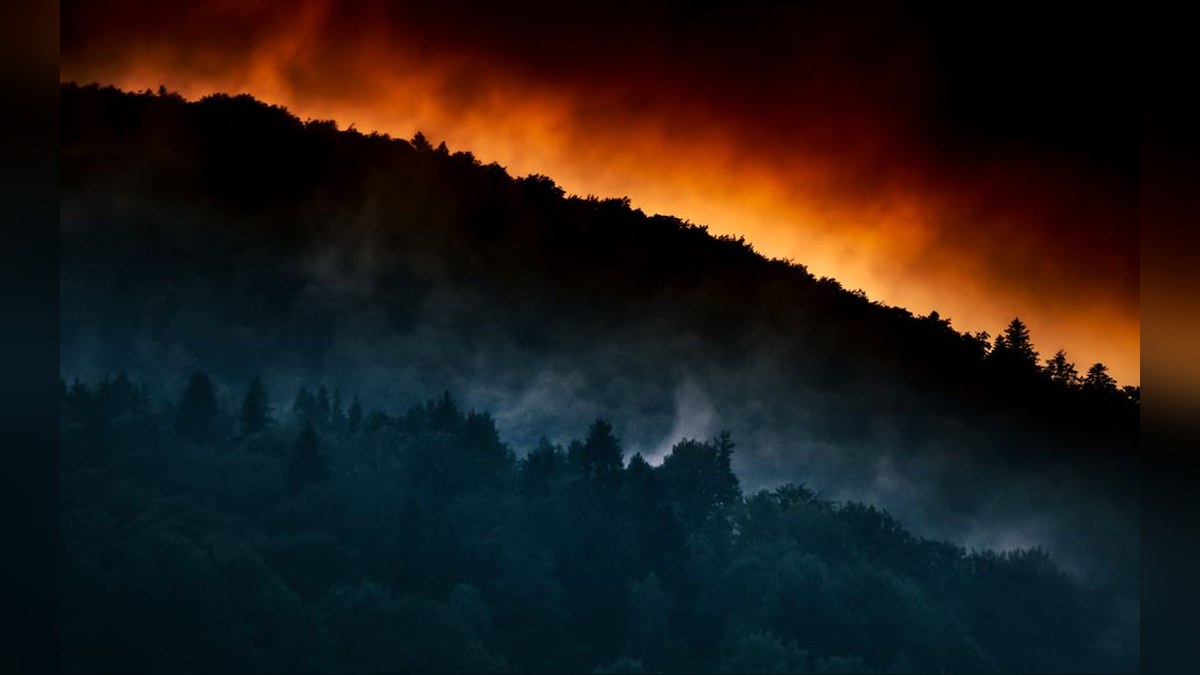
For the first time in history, French firefighters are facing a ‘pyrocumulonimbus’ — an extreme atmospheric phenomenon generated by the gigantic forest fire devastating southwestern France. The information was confirmed by the spokesperson for the National Federation of French Firefighters (FNSPF), Lieutenant Colonel Eric Brocardi, in an interview with AFP.
The formation, also called cumulonimbus flammagenitus, occurs when the intense heat of a fire warms the air near the ground, causing it to rise rapidly. This rising air cools and condenses, forming a fire cloud — a turbulent mass capable of generating its own winds, which worsen the flames. If the cloud grows enough, it can even produce lightning.
Until now, the phenomenon was only observed in fire-prone regions such as Australia and North America. NASA nicknamed it the ‘fire-breathing dragon of clouds’.
Brocardi explained the mechanism: ‘The increase in ground temperature at the heart of the fire is so extreme that the intense heat rises in a column, meeting colder air masses at the top. This contact creates a pyrocumulonimbus — or fire cloud — unfortunately devoid of moisture. This smoke cloud generates its own weather system, causing everything in its path to spontaneously combust.’
‘Lightning forms inside the cloud, strikes the embers on the ground, and further fuels the fire,’ he added. ‘It produces a deep, rumbling sound. This type of fire occurs regularly in Canada and Australia, but it is unprecedented in France.’
Controlling the fire is an unprecedented challenge. ‘We are dealing with a so-called ‘convective’ fire, which creates its own winds — winds that constantly change direction, unlike a standard fire that spreads in a conical shape. The result is that it spreads in all directions and develops multiple fire fronts, making the situation completely unpredictable,’ Brocardi said.
‘We don’t know how the fire will spread; the fire front is changing all the time. We cannot fight it directly. It’s a David vs. Goliath scenario: the idea is that at some point, we will find a weak spot and attack there.’
Salvation, according to the spokesperson, will come from the sky — in the form of rain, although it needs to rain heavily for three days — or by finding a way to direct the fire to a place where it extinguishes itself, such as the sea.
Regarding the firefighters’ hopes, Brocardi was realistic: ‘We have reached a point of ‘operational impossibility’ that requires accepting the need for strategic withdrawal — understanding and recognizing a natural force beyond our control. The situation on the ground is defensive, not offensive; it is a war scenario, where we are under constant bombardment and need to get everyone to a safe place.’
‘We realize we are facing a situation where we are powerless. However, this powerlessness leaves no room for despair. It is certain that all efforts will bear fruit. It is out of the question that firefighters feel their work in the field is in vain.’
‘Every action — defending critical locations, rescuing animals — gives new breath to the efforts, driven by their fierce determination. There is a support force ready to replace them. However, not all firefighters in France can simply converge here, because the risk exists everywhere. We have to hold the line.’
The interview was conducted by journalist Juliette Collen from AFP and originally published by France 24.